Free on-site consultation
Manufacturing, warehouse, construction, and food-processing environments run on clear communication — for safety, for quality, and for the bottom line. When instructions get missed on the floor, it isn’t a minor inconvenience; it’s a safety incident waiting to happen, a quality hold, a missed shift handoff.
The LC Institute delivers on-site English training built specifically for industrial teams: the terminology, safety language, and shift-communication your floor depends on, taught in person by a bilingual instructor who can bridge from Spanish to English. This is the manufacturing and industrial English training service — one of six on-site programs The LC Institute offers North Atlanta employers, and the one built most deliberately around plant, warehouse, and jobsite realities.
Built for the floor, not the classroom
Most ESL training was never designed with a production floor in mind. It was built for a classroom, or a language app, or a general-purpose curriculum meant to work everywhere — which usually means it works nowhere in particular. Generic ESL teaches “the weather” and “ordering at a restaurant.” It doesn’t teach the word for a lockout tag, the phrase a supervisor uses during a shift handoff, or how to read a machine’s warning label. On a plant floor, that gap isn’t academic. It’s the difference between an employee who understands a safety briefing and one who nods along without following a word of it.
Off-site classes create a second problem: attendance. Ask employees to drive to a night class after a ten-hour shift, and most won’t make it more than a few weeks. Apps fare no better — self-paced language software has no accountability, no correction, and nothing tailored to the specific machines, procedures, and hazards of your workplace. Employees stop logging in, and the company is left with the same communication gaps it started with.
The LC Institute takes a different approach. Training happens at your facility, built around the language your team actually needs — not a generic unit plan, but vocabulary and scenarios pulled straight from your floor. Classes are taught live, in person, by a real instructor who can answer a question, correct a misunderstanding on the spot, and adjust the lesson when she sees confusion on a trainee’s face. That’s something no app or off-site class can replicate, and it’s why on-site, industry-specific training closes the gap that generic ESL leaves open.
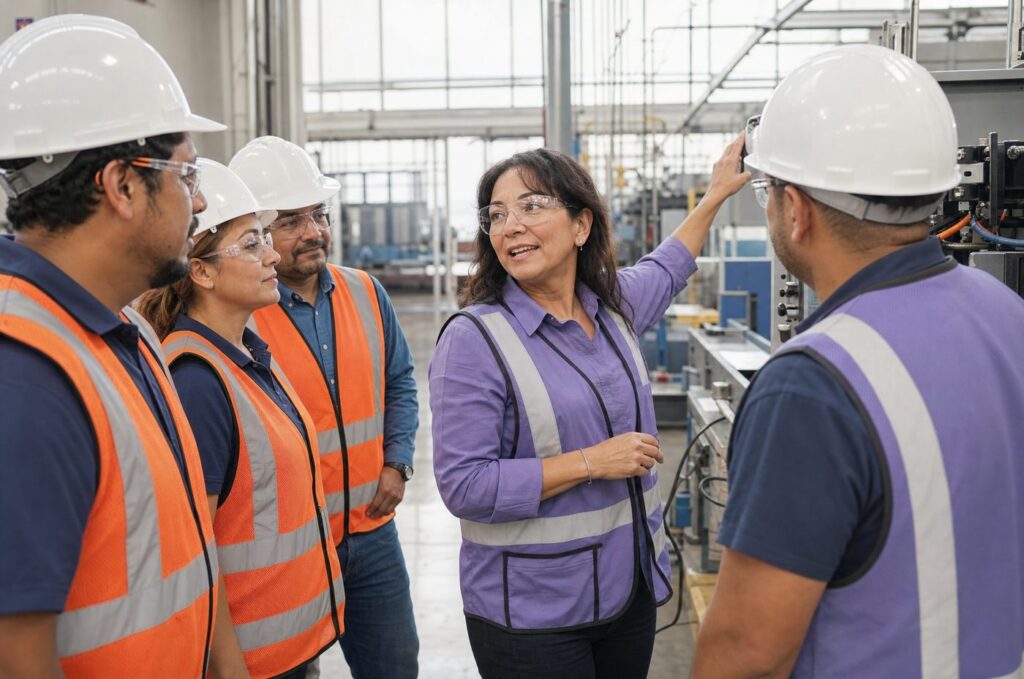
What your team learns
Every program starts from the language your operation actually runs on, not a standardized textbook. Depending on your team’s roles, that typically includes:
- Manufacturing and equipment terminology — the names of machines, tools, materials, and processes your employees use every shift.
- Safety procedures and protocols — the vocabulary behind lockout/tagout, PPE requirements, hazard communication, and emergency procedures.
- Quality-control communication — describing defects, reporting inconsistencies, and following inspection standards clearly and accurately.
- Shift handoffs and reporting — the specific language used to pass information from one shift or crew to the next without anything getting lost.
- Production-workflow communication — following work orders, understanding schedules, and communicating delays or issues up the chain.
- Team coordination — the everyday exchanges between coworkers, leads, and supervisors that keep a line, a crew, or a warehouse moving.
- Reading labels, SOPs, and safety signage — building the reading comprehension employees need to follow written procedures independently, not just verbal instruction.
Because the curriculum is built from a needs assessment of your specific operation, two companies rarely get identical lesson plans. A food-processing plant needs different vocabulary than a construction crew; a warehouse needs different reading skills than an assembly line. That specificity is what makes the training usable the same week it’s taught.
Give your floor the English it actually needs.
A short consultation is all it takes to see what on-site industrial English training looks like for your team.
Industries we serve
The LC Institute works primarily with manufacturing and construction companies — Coach Cynthia’s specialty and the industries she’s built the majority of this curriculum around — along with warehousing, logistics and distribution, and food-processing operations across North Atlanta.
- Manufacturing — assembly, fabrication, and production-line teams who need shared vocabulary for equipment, quality standards, and safety procedures.
- Construction — crews who need clear, fast communication around jobsite instructions, tools, materials, and safety protocols in a fast-moving, often changing environment.
- Warehousing — teams managing inventory, pick-and-pack processes, equipment operation, and coordination across shifts and departments.
- Logistics and distribution — staff coordinating scheduling, loading, routing, and handoffs where miscommunication can ripple through an entire operation.
- Food processing — teams where sanitation standards, safety protocols, and quality communication carry especially high stakes.
Every industry gets its own vocabulary and scenarios rather than a one-size-fits-all program, because the English a machine operator needs and the English a loading-dock coordinator needs simply aren’t the same.
Why bilingual instruction matters here
Many industrial teams across North Atlanta are majority Spanish-speaking, and that reality shapes how The LC Institute teaches. Coach Cynthia is bilingual in English and Spanish, and she uses that bridge deliberately: instruction is delivered in English, the language employees need to build, but she can step into Spanish to explain a concept, clarify a safety term, or make sure a beginner isn’t lost in a lesson that’s moving past them.
That matters most with safety-critical language, where a partial understanding is nearly as dangerous as no understanding at all. An employee who’s “mostly following” a lockout procedure or a chemical-hazard warning isn’t actually safe — they’re guessing. Bridging from Spanish lets true beginners build a foundation in the words that matter most, quickly and accurately, instead of struggling silently through English-only instruction and hoping context fills in the gaps. As employees progress, the Spanish bridge fades and English instruction carries more of the lesson — but it’s there from day one for the employees who need it, which is often the difference between a program that works and one that loses people in the first two weeks.
This bilingual approach is also why families and coworkers often describe Coach Cynthia’s teaching as patient and encouraging rather than intimidating. Employees who are nervous about their English are far more willing to speak up, ask questions, and practice out loud when they know they won’t be left behind if they stumble — and that willingness to participate is what actually drives progress.
How on-site training works around production
On-site training only works for a plant or warehouse if it respects the realities of production — and The LC Institute builds every schedule around yours, not the other way around.
- Flexible scheduling across shifts. Classes can be arranged around first, second, or third shift, staggered start times, or rotating crews, so training doesn’t force a choice between attendance and production.
- Classes at the facility. Instruction happens on-site — in a breakroom, a training room, or wherever makes sense on your floor — so employees don’t lose time commuting to a separate class.
- Small, level-based groups. Employees are grouped by current English level so beginners aren’t lost and more advanced learners aren’t held back, keeping every session useful for everyone in the room.
- Minimal downtime. Sessions are scheduled in the windows that work for your operation — before or after shifts, during breaks, or in dedicated blocks — so training adds capability without pulling people off the floor for longer than necessary.
The process starts with a needs assessment: Coach Cynthia evaluates current English levels across the roles involved and talks through your communication goals and pain points. From there, she builds a curriculum around your industry and schedule, teaches it live on-site, and shares progress evaluations along the way so you can see what’s improving and what to focus on next.
Benefits for your business
Employers bring The LC Institute in because the payoff shows up in daily operations, not just in a training log:
- Improved workplace safety — employees who genuinely understand safety briefings, signage, and procedures, not just the ones who nod along.
- Fewer communication errors — clearer instructions and reporting mean fewer mistakes, redos, and missed steps.
- Better understanding of procedures — SOPs, quality standards, and equipment instructions that employees can actually read and follow independently.
- Higher productivity — less time lost to confusion, re-explaining instructions, or correcting avoidable errors.
- Stronger team coordination — smoother shift handoffs, clearer reporting up the chain, and better day-to-day collaboration between crews and departments.
Beyond the operational gains, employers consistently notice something else: employees who feel more confident communicating tend to engage more, stay longer, and take more ownership of their work. Communication training isn’t just a safety or compliance measure — it’s a workforce-development investment that pays back in retention and morale.
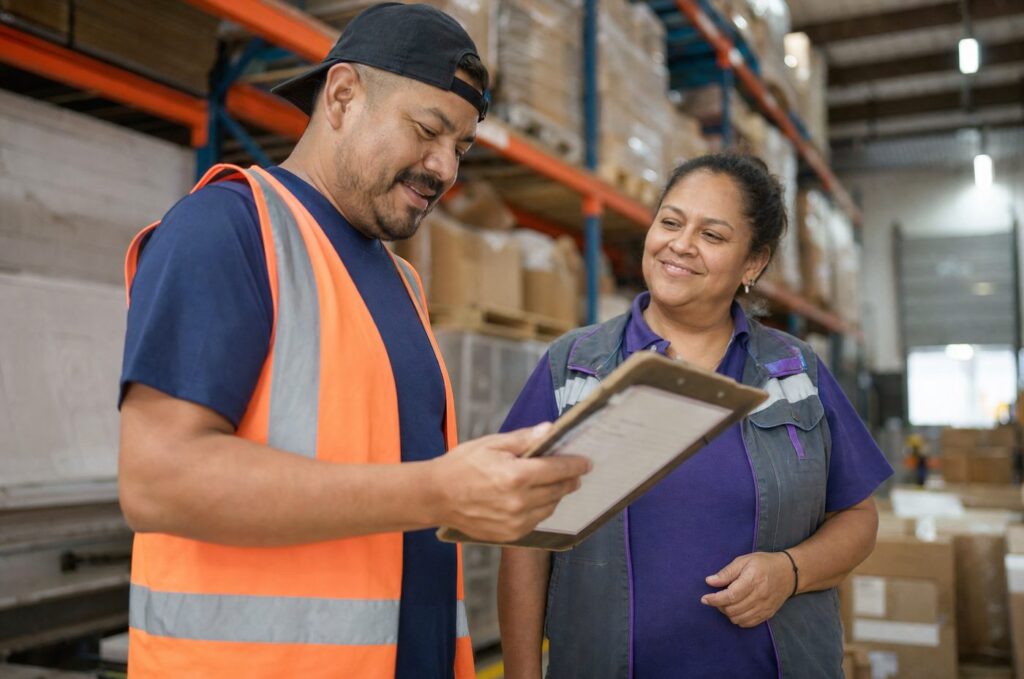
What clients say
“She comes to the company to teach us… explains grammar and vocabulary very well.”
— Manuel
“The classes are held right at our workplace, which is very convenient and saves us time.”
— Gregorio
Frequently asked questions
Yes. Safety-critical vocabulary is one of the most common reasons manufacturing and industrial employers bring us in. We build lessons directly from your signage, standard operating procedures, and PPE requirements, so employees learn the exact language they'll see and hear on your floor, not generic safety phrases from a textbook.
Yes. On-site training is built to fit your production schedule, not compete with it. We can arrange classes around first, second, or third shift, staggered start times, or rotating crews, so you're not forced to choose between attendance and keeping the line running.
No. We assess each employee's current level during the needs assessment and group learners accordingly, from true beginners up. Training is built to meet employees where they are, not to assume a starting point they haven't reached yet.
Yes. Coach Cynthia is bilingual in English and Spanish and bridges from Spanish when it helps a beginner understand a concept, especially with safety-critical language where a partial understanding isn't good enough. Instruction is delivered in English, with Spanish used as a bridge — not a replacement — so employees build real English ability over time.
Our core focus is manufacturing and construction, and we also work regularly with warehousing, logistics and distribution, and food-processing teams across North Atlanta. Every program is built around your specific industry's vocabulary and safety requirements rather than a generic curriculum.
Yes. While manufacturing and construction make up the majority of our industrial clients, we regularly train teams in warehousing, logistics and distribution, and food processing — each with vocabulary and scenarios built specifically for that environment.
Every program is customized to your team size, industry, and goals, so we don't publish flat pricing. After a free consultation, we'll walk your floor's needs and give you a clear, straightforward quote — no guesswork, no one-size-fits-all pricing.
Ready to close the communication gap on your floor?
Request a free on-site consultation and we’ll build a manufacturing and industrial English training plan around your team, your shifts, and your industry.